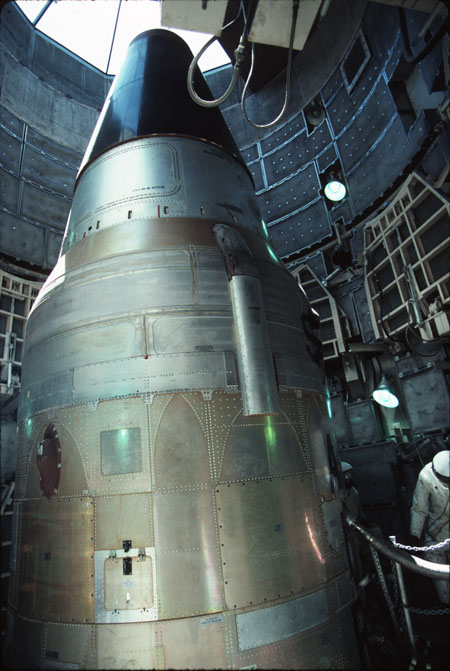
I think the world is just now starting to realize that nuclear weapons are an inevitable part of the world's future. North Korea has about 2-5 nuclear weapons, and Iran is vigilantly pursuing nukes much to the discontent of the Western World. It is time to realize, nuclear weapons are not going away. They are only going to spread over the next couple of decades. While I would love to be able to keep nuclear weapons out of the hands of terrorists and crazed dictators throughout the world, it is simply not going to happen. North Korea is a recent failure of the international community in preventing nuclear proliferation. Many of my detractors will say the North Korean example is counteracted by the example of Libya giving up its nuclear program years ago. I contend that Libya's reversal of policy is the last of its type. It is far too easy to figure out how to make a nuclear weapon for countries with the scientific know-how and access to Plutonium or Highly Enriched Uranium (HEU) (I've read enough books on nuclear weapons to be able to simply explain two ways to create a nuke without help).
I do not contend we should stop from trying to stem the spread of nuclear weapons, but instead we should also work on international safeguards beyond the toothless treaties to which all states are signatories (NPT). Instead we need to work on having all nuclear devices outfitted with Permissive Action Links (PALs). PALs simply are a mechanism which by which nukes are safeguarded from unintential activation or detonation. Along with PALs there needs to be a more concerted international effort to secure weapons grade Plutonium and HEU to ensure it does not fall into the hands of terrorists.
Showing posts with label PALs. Show all posts
Showing posts with label PALs. Show all posts
Tuesday, June 2, 2009
Monday, May 25, 2009
North Korea -- What to do?
I refrained from posting about this yesterday when North Korea set off their second nuclear test in three years because of the lack of definitive information about the test. This nuclear test was carried out in the northern province of Kilju, the same location of the 2006 test. There is no official determination of the yield of the weapon tested, Russia has reported up to 40 Kilotons, other reports indicate as low as 4 Kilotons. The 2006 test was a low yield bomb of 1 kiloton (equivalent to 1,000 sticks of dynamite, considered relatively low for a nuclear weapon). Aidan Foster-Carter perceptively writes that North Korea is clearly not going to be the next Libya and give up their nuclear weapons program. Assuming that North Korea, under no condition, is going to give up their nuclear program, then we must find another way to negotiate with North Korea. The past six years of so-called Six Party Talks has yielded no results other than an empty promise of North Korea abandoning its nuclear program. With that promise now void, another strategy must be devised.
New negotiations with Pyongyong must take on a different tone now, one that encompasses much more than their youthful nuclear program. Most who follow North Korea in the news know about their starving population and the "secret" forced labor camps which are inhabited by those who dare speak against the government. With these conditions in mind, the US and other states must find a different way to negotiate with the DPRK.
We must realize that putting sanctions on North Korea again, will not do much, except further starve the citizens. There needs to be a way to integrate them into the global system in a meaningful way so that they will stop threatening those around them and they loosen the stranglehold on the economy and citizens.
We have to do a couple of things in my opinion:
1. Actually find a credible negotiator (preferably Kim Jong Il himself)
2. Ask exactly what they want; if it is a nuclear program, we need to draft an agreement which allows IAEA inspectors to all of the nuclear facilities, there need to be efficient safeguards (PALs, etc), there needs to be an agreement to prevent the distribution of nuclear material or dual-use technologies.
3. In return for being brought into the international community, there needs to be some sort of assurance that the citizens are allowed additional freedoms, especially easy access to food.
Other things are also needed, but this is just a start. I do not think many people really understand what Kim Jong Il really wants out of this program. We need to understand his thinking before we can effectively negotiate. If we can reach a mutual agreement it is easier to assuage the tensions on the Korean Peninsula.
New negotiations with Pyongyong must take on a different tone now, one that encompasses much more than their youthful nuclear program. Most who follow North Korea in the news know about their starving population and the "secret" forced labor camps which are inhabited by those who dare speak against the government. With these conditions in mind, the US and other states must find a different way to negotiate with the DPRK.
We must realize that putting sanctions on North Korea again, will not do much, except further starve the citizens. There needs to be a way to integrate them into the global system in a meaningful way so that they will stop threatening those around them and they loosen the stranglehold on the economy and citizens.
We have to do a couple of things in my opinion:
1. Actually find a credible negotiator (preferably Kim Jong Il himself)
2. Ask exactly what they want; if it is a nuclear program, we need to draft an agreement which allows IAEA inspectors to all of the nuclear facilities, there need to be efficient safeguards (PALs, etc), there needs to be an agreement to prevent the distribution of nuclear material or dual-use technologies.
3. In return for being brought into the international community, there needs to be some sort of assurance that the citizens are allowed additional freedoms, especially easy access to food.
Other things are also needed, but this is just a start. I do not think many people really understand what Kim Jong Il really wants out of this program. We need to understand his thinking before we can effectively negotiate. If we can reach a mutual agreement it is easier to assuage the tensions on the Korean Peninsula.

Subscribe to:
Posts (Atom)