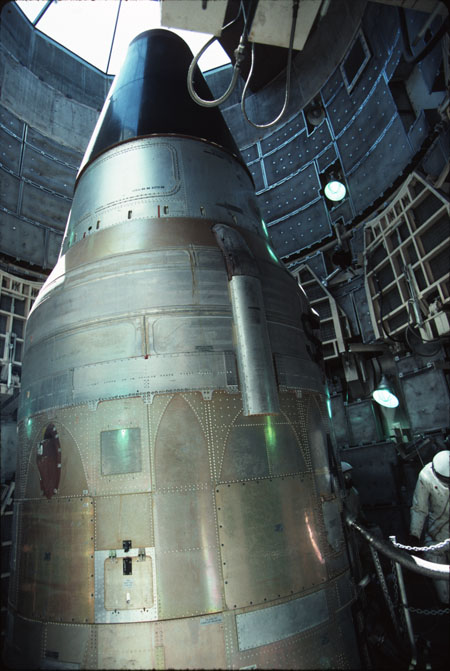
I have a problem conceding that we have moved into a world of multipolarity. This would assume that one or more countries have thus increased their political/military/financial clout to the US's level or surpassed that level. I have read the statistics that China has passed Japan as the world's second largest economy and that China holds much of the US trade debt. From a purely economic standpoint I agree that we have moved (or are moving) into multipolarity. Yet many articles which discuss this topic seem to qualify their arguments through alluding to military power.
This source doesn't take a stance on whether the world has moved into multipolarity, yet it illustrates my point in the second paragraph. Using terms like, "...rapidly evolving threat environment." seems to indicate that we are headed towards a war. Perhaps China is poised to utilize the world's largest military against the US? Did I miss those headlines? Does anyone actually believe Iran or North Korea can challenge the US in a full scale military
confrontation (or any other sort of confrontation for that matter)?
So then what is this discourse about the threat environment which apparently is an argument for multipolarity? Is the global (leaderless) jihad threatening the unipolar order? I am wondering if I am the only one which has noticed these conflicting discourses in polarity discussions.
Thursday, October 7, 2010
Monday, July 19, 2010
Video
Video Posted By Cirincione via Twitter:
Just something for those who are still interested in arms control. I feel that arms control is a dying subject, giving-way to the study of irregular warfare and insurgency. Either way, it is still something which needs a significant amount of attention from our policy makers.

Monday, July 12, 2010
New Beginnings
I fly back to London tomorrow morning. Right now I am trying to stay up in order to be able to sleep a bit on this flight.
I'm looking to restart this blog after my dissertation is due; so I will post a few times on this in order to gain some interest, to begin gathering hits again. I may also be bringing on another blogger who posts mainly on Hubpages; he writes primarily on local level, and domestic politics issues. Dissertation is due Sept. 6, looking forward to writing for recreation again.
I may give an executive summary of my dissertation closer to its due date. Due to the possibility the faculty grading it may search passages of my dissertation on the internet, I will not be posting it here. The process of proving this is my blog would be horrifying, I imagine. What I will say it involves a case study of Kazakhstan and makes conclusions about the nature of the state centric system and discourse of the state.
PS: If anyone does read this ever, I'd be interested in hearing ideas for other places to host this blog. I'm thinking this layout looks a bit....bland.
Sunday, August 2, 2009
Geopolitics -- France
In keeping with my field of study for next year (“Geopolitics and Grand Strategy”) I have decided to compose a couple of articles about the geopolitical importance of multiple countries.
France will be the target of today’s post.
Looking at a map of Europe, France holds a very powerful position. It borders seven countries and two bodies of water. Andorra, Spain, Belgium, Germany, Switzerland, Monaco and Italy all border France. The English Channel separates France from the only other European nuclear power, the United Kingdom. The Mediterranean Sea separates France from the north coast of Africa and the Western-most coast of the Middle East.
France has neared superpower status on multiple occasions, most notably the reign of Napoleon being the closest. Instead of growing into its potential, France has been subject to English domination in the 18th century and then subjected to Nazi rule in Germany. Now France holds an interesting position where they may hold the key to the ambitions of the US in Eurasia.
Generally speaking, in a vote that splits the UNSC East v. West the votes will be grouped with China and Russia on one side and France, UK, and the US on the other side. If you need proof of this, look at past votes over whether to impose sanctions on North Korea and Iran. It is hard to imagine the US without the UK by its side. The US/UK alliance is an impotent duo at best. The UK lost its geopolitical importance during the Second World War; since 1945 the UK has failed to be a geopolitical player. It may be a subject of their distance from West/East divide (which I would put probably in Eastern Europe descending on the Eastern border of the Ukraine and Turkey, both of which will be the subject of this series in the upcoming week) or their impotency on the world stage. The other duo is the “Eastern Alliance” (as I will call it) of Russia and China which will reliably protect their interests both in the Middle East and East Asia. This is where France’s situation becomes interesting.
For most who pay attention to international politics, France is often an unreliable, erratic actor. Sometimes they are staunch allies of the United States and other times they are the first to criticize the US. In a contested vote on the Security Council, France often holds the deciding vote. This makes the relationship between the US and France a delicate one. With the rise in potency of the European Union in the past decade France also has the ability to united Europe to reassert itself as the world’s superpower (I say ‘reassert’ referring to the time when Europe was the head of exploration and colonialism). France has the unique ability to do this because of their geographic location, their nuclear weapons stockpile (third largest in the world), and their ability to lead. When consulting my peers about the question of leadership in Europe many asserted it was Germany, not France, had the ability to lead. I think Germany has two problems. The first being the most obvious, they are not a part of the nuclear club. The second harkens back to World War II and Nazi rule. There is still a collective memory of the Holocaust which weighs heavy on any assertion of German leadership. Therefore Germany holds the excellent ability to fight for a united Europe without German leadership.
If Europe united with France leading the way into 2010 and beyond, the US may have to rethink its strategy in Europe. The hundreds of thousands of US troops stationed in Europe would be forced to come home, and the US would lose influence on the world’s largest land mass and population center (Eurasia).
France is clearly the main player in European geopolitics; they hold the key to the entirety of Europe, both in and out of the UN. The alliance between the US and France one that is necessary of frequent nurturing. A hostile France could substantially limit the power of the United States in Eurasia.
Thursday, July 30, 2009
Qatar's North Field
In 2006 Qatar quietly announced the development of natural gas refining facilities in their North Field which is also part of the South Pars gas field which belongs to Iran (there is no geological separation; the split occurs at the Qatar - Iran maritime boundary). Here is a map of the area:
The North Field is expected to supply approximately 14% of the world's gas supply; South Pars is expected to contain 10%. Adding to the already LOADED area; this area is non-associated natural gas which means it contains little crude oil and requires less processing.
Iran and Qatar currently have a good relationship despite Qatar's willingness to host US troops. Qatar and Iran cooperate on OPEC, the Non-Aligned Movement, and Organization of the Islamic Conference. Together they hold 24% of the world's natural gas supply which may hold the key to relieving the world's reliance on oil.
Saturday, July 25, 2009
One More Won't Hurt
I found this too interesting to not post:
Jeffrey over at ArmsControlWonk came into possession of some DPRK bank-notes and had them scanned onto his blog. You'll notice the 5 is nuclear themed, very interesting!
Jeffrey over at ArmsControlWonk came into possession of some DPRK bank-notes and had them scanned onto his blog. You'll notice the 5 is nuclear themed, very interesting!
It's Been a While
Sorry I haven't posted in a while, it's been a busy past week and a half...
Just a quick post for tonight, I'm not going to be able to post until next Friday likely.
I do not know how many of you subscribe to the Economist; every year they put out a "Pocket World in Figures," and I have marveled at this little invention for a while. This book takes a wide variety of statistics and puts them into a small but easy to use handbook. Flipping to a random page I find that:
70% of Cameroon's employment is in the agriculture sector.
or
Macedonia has the highest percentage of unemployed labor in the world at a mere 36.0%, that's pretty incredible.
Other statistics include defense spending and total attendance to cinemas per country (India has the highest in 2006 at 1,473.4 million attendees).
If you are a statistics nut (which I am though I am terrible at any sort of mathematics) this is a must have, it just packs so much information into such a small space.
In the next week I'll be reading Zbigniew Brzezinski's The Grand Chessboard and the newest Economist which is labeled, "Waking from its sleep: A 14-page special report on the Arab world"
Until next time keep abreast on world issues and read some books!
Monday, July 13, 2009
My Response to Mr. Richard Butler
Today's post will be cut short a little, I intended on composing a much more lengthy post on cars and oil, but that will be saved for another day. I will be responding to Mr. Butler's view of nuclear weapons.
If you did not get a chance to watch his interview, I still would recommend you at least watch the first ten minutes. The claims which Butler makes about nuclear weapons (obsolete, unnecessary, outdated; among other claims) I find far too idealistic. I prefer a bit more realist point of view.
"Speak soft but carry a big stick" -- Teddy Roosevelt
Nuclear weapons are far from a thing of the past; rather, they are the weapon of the future. It is sad, both in my view and in Mr. Butler's view that this is true; but it is...
Nuclear weapons are not going away anytime soon. Currently there are nine nuclear weapon states:
1. United States
2. Russia
3. China
4. United Kingdom
5. North Korea
6. Israel
7. Pakistan
8. India
9. France
President Barack Obama and President of the Russian Federation, Dmitri Medvedev just held talks on the status of nuclear weapons and decided on a goal of reducing the number of deployed nuclear weapons. This goal hardly accomplished anything as I noted a few days ago.
As long as there are countries pushing for a military edge the world, there will be nuclear weapons. That is the truth, I invite anyone who disagrees to email me and we can continue that discussion. Last time I checked, India and Pakistan still have disagreements over Kashmir; Iran is still threatening to wipe Israel off the map (and vis versa); and North Korea is still threatening war against South Korea and the US....Nuclear weapons are not going away.
The simple fact is that nuclear weapons give us the "Big Stick" that Teddy Roosevelt spoke about many decades ago. Until the world realizes how bad a nuclear attack would be, there will be no elimination of nuclear weapons.
The need for them comes from the "macho" posturing that dominates international politics. There is no way to threaten a state that has a nuclear weapons when you have an army and some rifles. The fact is strategic competition on the world stage is composed of "I have more nukes than you." We need to focus our efforst not on eliminating nuclear weapons, but on having more control.
Here is a link to a post I wrote about a month ago about nuclear weapon safety. Enjoy.
Saturday, July 11, 2009
Interview with Richard Butler of Penn State
Big thanks to Penn State Public Broadcasting for submitting this video. This is an interview with former Ambassador and current Professor Richard Butler. In this interview he shares his views of nuclear proliferation, foreign aid, and freedom of expression.
While I do not agree with some of the opinions presented in this video, I think Butler does give some excellent analysis about pressing issues in the world today.
While I do not agree with some of the opinions presented in this video, I think Butler does give some excellent analysis about pressing issues in the world today.
Monday, July 6, 2009
We've Been Had!
President Obama recently finished negotiations with Russian President, Dmitri Medvedev over nuclear weapons stockpiles. Both leaders came out of the negotiations confident the meetings went well and also came out with an agreement to reduce the amount of deployed nuclear weapons by each country.
The grand total each country must reduce their deployed nuclear weapons by:.......25.
Yes, that's right, 25 nuclear weapons. Out of the near 1500 deployed nuclear weapons we're going to reduce the amount by twenty-five nukes. That's not much of a deal. The US and Russia can still bomb each other back to the stone age, what's the difference with 25 warheads?
Along with the miniscule reduction of warheads; Medvedev and Obama agreed to create a joint data exchange center. My question is, what happened to the one Clinton and Yeltsin set up in 1998? As far as I can tell they are working on the same thing... (Image reproduced from http://msnbcmedia.msn.com/j/msnbc/Components/Photos/070423/070423_yeltsin2_hmed_7a.hmedium.jpg)
Obama, did you accomplish anything worthwhile?
The grand total each country must reduce their deployed nuclear weapons by:.......25.
Yes, that's right, 25 nuclear weapons. Out of the near 1500 deployed nuclear weapons we're going to reduce the amount by twenty-five nukes. That's not much of a deal. The US and Russia can still bomb each other back to the stone age, what's the difference with 25 warheads?
Along with the miniscule reduction of warheads; Medvedev and Obama agreed to create a joint data exchange center. My question is, what happened to the one Clinton and Yeltsin set up in 1998? As far as I can tell they are working on the same thing...
 (Image reproduced from http://msnbcmedia.msn.com/j/msnbc/Components/Photos/070423/070423_yeltsin2_hmed_7a.hmedium.jpg)
Obama, did you accomplish anything worthwhile?
Wednesday, July 1, 2009
Can Capitalism Be Effectively Resisted?
This topic struck me the other day when I was Blockbuster and saw a two-part documentary on Che Guevara, the Marxist/Socialist revolutionary himself. I thought to myself at that instant, would Che Guevara support a documentary on himself on the shelves of a Blockbuster? I concluded he probably would not be too pleased.
I have contemplated whether resistance to capitalism is futile at many points in the past couple years. Here's a couple of examples:
1. Slavoj Zizek -- Slovakian professor and theorist extraordinaire. All around capitalist hating badass if you ask me. He's got multiple books about everything from Socialism to ethics of the Real. His "brand" if you will is now a sign for everything capitalism hates; yet capitalism touts Zizek as the ultimate resistance to itself. In my opinion it just proves how much you cannot stop capitalism.
2. China -- Yes China. This isn't breaking news for those of you who pay any attention to the news in the past decade. I believe it was 1994 when the PRC opened its first "Special Economic Zone" (SEZ). These zones essentially were areas of free market capitalism surrounded by rest of communist China.
China still sometimes decides to play the communist card in the international arena; but any semblance of true communism (they never actually made it to true communism) died years ago.
in the Summer of 2008 many critics predicted the fall of capitalism after the collapse of many US financial institutions. It seems now capitalism has withstood the worst of the recent recession and is rebounding. Marx predicted that capitalism was susceptible to periodic recessions; but he did not predict how incredibly durable capitalism has become. Through multiple long term and short term recessions it has been modified to whatever the situation necessitates.
Capitalism simply coops anything that stands against in its way. It seems that to truly stand against capitalism, you must truly stand against human nature, or at least democracy. Zizek writes that capitalism and democracy are so intertwined that you must fight against democracy to fight against capitalism; separating them would be impossible. But in order to fight against democracy you must fight against the largest purveyor of democracy: the United States. No state or terrorist organization seems to have been able to destroy the US yet, good luck at defeating capitalism.
Thursday, June 25, 2009
Soccer: the World's Game
I have been reluctant to be one of those who follows soccer (futbol for all those who prefer the more authentic term) even after I played soccer for nine years as a child. I just never could get into it; they score so few goals, and it just looks like boredom punctuated by moments of sheer ecstasy (or pain, depending on which side you're on). I have just recently found the patience for soccer and now I'll never go back.
What changed my mind was the second half of the US-Spain match in the FIFA Confederation Cup. This was compounded today watching the Brazil-South Africa match.
IBM commercials will try to convince you that math is the only language that all cultures share. I call BS! Soccer will join that elite club as soon as it catches on further in the US. But I think changes need to be made, we need some cool teams to root for; I'm sorry, but I cannot get behind a team called "Galaxy" or "Chivas USA," forgive me Galaxy and Chivas fans. I can't even get behind a league called Major Leage Soccer. Take a look at the name of teams from abroad:
Fulham
Chelsea
AC Milan
and leagues named:
Premiere League
Champions League
I am sorry, but those named are just so cool! Galaxy just pales in comparison. Let's start naming our teams after where they're from, the Galaxy can be Los Angeles FC, that's WAY better.
But back to the topic at hand. Soccer has the power to unite war torn countries, Siera Leone is currently trying to unite the country behind their soccer team which will compete in the World Cup in 2010 (hosted by South Africa). I *believe* there was a mutual temporary cease fire in Sierra Leone during the last World Cup (hosted by Germany in 2006). Did you see those fans during the Confed Cup? They go NUTS for their team, this is nationalism manifesting itself through sport, it's beautiful. Jump on board America.
Wednesday, June 24, 2009
How Twitter Saved Iran
As most of you know, Iran has come uncorked in the past few weeks since the presidential election. Protests have marred the top international headlines everyday in protest of President Ahmadinejad's win. Even under pressure from the government to silence the protests which have continued to this day (check BBC). But there was one source of information that Iran could not silence: Twitter.
I will be the first to admit, I loathe those who update their Twitter constantly. I just cannot stand to think about sitting around telling the world what I am doing every second of every day. Life has a tendency to make me wrong lately, and this time Twitter and Iran proved me wrong. Even when the government struck back and arrested hundreds and silenced crowds; the protesters went to Twitter, and it became a live news feed from Iran. The developers of Twitter had routine maintenance scheduled for the middle of day in Iran, but changed it due to the importance of what was occurring.
Just scanning "Iran election" on the Twitter search results, I have 18 new "Tweets" in about 3 minutes, and one (without refreshing to get the new results) reads ""Iran: Release All Those Detained for Peacefully Opposing the Election Results." Please sign this petition and retweet. http://bit.ly/17iqS7"
As you can see even though the government will continue to try and crush protests, the movement will live on through Twitter.
Monday, June 22, 2009
France Gets Religious
French President Nicolas Sarkozy recently made a major policy speech condemning the wearing of a Burka in France. This speech comes after the 2004 decision to outlaw headscarfs in public schools.
This is a terrible thing for Sarkozy to do. He faces dwindling popularity among supporters and continously alienates the large Muslim population in France.
This is a terrible thing for Sarkozy to do. He faces dwindling popularity among supporters and continously alienates the large Muslim population in France.
Tuesday, June 16, 2009
The Lighter Side of IR
Here's a funny post I found on Foreign Policy's website. Antonio Castro (yes, Fidel's son) got duped into an 8 month online relationship with a man, posing as a woman named, "Claudia." Along with being fooled into talking with this man for 8 months, Antonio gave "Claudia" advanced information about a trip to Mexico, and details of a far from average lifestyle that included gorgeous beaches, and Lacoste shirts. You can read the article here.
Saturday, June 13, 2009
Pictures from the Election
For those of you who have been following the Iranian election, here are some beautiful pictures from the past few weeks.
North Korea Threatens the US
Last night I was reading my last batch of news before going to sleep when I see a small article on BBC.com saying the state television station of North Korea has carried a message the US:
Any attempt to interfere with North Korean ships would be seen as an act of war and would require military action.
My question is; Who is North Korea kidding? The UNSC just UNANIMOUSLY approved new sanctions against the pariah state. China and Russia, typically defenders of North Korea in the UN, surprisingly voiced no opposition to the new sanctions. If North Korea launched an attack against the South, or even US property abroad, do they really think they would survive? The South and Japan would most definitely take part in this military operation. What makes them think they would not be the next Afghanistan or Iraq?
Even if they did threaten a nuclear attack, most of the world is not completely sure they would be able to effectively launch the weapon.
Maybe after the transition of power between Kim Jong-il and his son this situation will settle down.
Wednesday, June 10, 2009
More Thoughts On North Korea's Nuclear Tests
Geoffrey Forden over at armscontrolwonk.com raises an interesting question about North Korea's nuclear tests. The question is, why did North Korea test both weapons underground?
Atmospheric testing allows scientists to photograph the explosion and the sun in the same frame in order to accurately determine the calibration of the bomb. All of China's nuclear tests have been atmospheric tests.
Could they really be trying to hide the tests from the international community? That doesn't seem like Kim Jong-il's style; he mocks the international community on a regular basis and probably would love to show off a shiny new nuclear weapon to the world. Even if he was trying to hide it, do you think the world would not have noticed the signature of a nuclear event? The ground shaking, gasses leaked, especially in the same area as the last test.
But maybe Kim Jong-il is caving to international norms of testing underground now.
Tuesday, June 9, 2009
Early Synopsis
Early Synopsis of The Road to Hell by Michael Maren:
So far Maren has mainly been telling a story of Chris Cassidy, who is an aid worker in Somalia (presumably before Maren arrives). The story illustrates the failures of US aid abroad. So many things get in the way of the aid helping those who are in need. The entire process is so politicized and so incredibly poorly put together, it is really remarkable more hasn't been said about these problems.
What most people do not realize is many of these "starving" countries have enough food to feed their citizens, in fact, in some cases they are exporting food. If the corrupt government exports food and starves people, aid agencies roll in with their bags of food and Land Rovers (Maren makes a point about how aid workers always drive Land Rovers. He mentions them almost ever other sentence; utilizing them as a means to show the inefficiencies and corruption in aid agencies). The aid workers bring contracts to the government who allows big mansions and beach clubs to be made for the aid workers while they skim some money off the top, making themselves rich. So as long as we come there and give them contracts, we fuel starvation; it is a self perpetuating system. Along with that, as soon as we give food, we make people reliant on our food, never allowing them to find a way to become self sustainable. It's a terribly cruel system.
More to come in a few days.
Saturday, June 6, 2009
New Paper Ideas
Thinking about beginning a new paper but I can't decide on a topic, here are the few I am considering:
1. Paper on the future of a world with more nuclear weapons. In the past 70 years, 9 states have been able to attain nuclear weapons, what does the future hold? I will contend we are entering the age where nuclear weapons proliferation is an inevitability. How do we deal with this problem?
2. "Minorities of Influence." I came up with this phrase while writing a paper on Druze in Israel. The paper would examine a couple minorities who either, a) have almost more influence than the majority or b) those minorities that could have tremendous influence, but have not seized the opportunity yet.
3. A further exploration of the Druze culture and religion. Could involve relationships between Druze in Arab, Syria/Lebanon and Jewish Israel. Also could involve diasporic Druze relationships between those in the Middle East and those in the US/Latin America.
If anyone randomly finds this blog, let me know what you think!
Subscribe to:
Posts (Atom)